
Mould only really goes when the cause goes with it.
We remove the mould down to a sound substrate, dry the structure until a moisture reading confirms it and finish with ozone. That way it stays gone, instead of coming back as soon as the paint is dry.
- Free site visit
- Fixed price up front
- Throughout Flanders
Cleaned off, painted over, and a month later it's back.
It's not down to how thoroughly you scrubbed. It's down to what lies underneath, and what is still keeping that wall damp.
The cause is still there
A leak, rising damp or a cold bridge keeps bringing in water. As long as that continues, any surface treatment is temporary.
The mould goes deeper
What you see is the growth on the surface. The threads sit in the pores of plaster and joints; a cloth removes nothing there.
Paint locks it in
Painting over it hides the stain for a few months. Underneath it keeps growing, and then it comes back straight through the new coat.
Mould that is left alone gets bigger.
On damp material, mould starts after 24 to 48 hours. After that the colony keeps growing as long as the moisture is there, and every day spores get into the air and settle elsewhere in the home.
Those spores are the real problem. They cause respiratory complaints, headaches and fatigue, and hit children, older people and people with asthma hardest. On top of that comes the damage to the building: affected plasterwork, peeling wallpaper and, in a cellar or crawl space, rot in the timber floor structure.
- Site visit
- Free, no obligation
- Price
- Fixed, agreed in advance
- Work area
- Sealed off, room by room
- Handover
- With a moisture reading as proof
Four steps, and the last one isn't the paint.
Mould removal is not a clean-up but a sequence. Skip a step and you'll be doing it again within the year.
Measure first: where is the moisture coming from? A leak, rising damp, a cold bridge or simply too little ventilation. Without that answer, any treatment is temporary.
The work area is sealed off so that spores don't spread through the home. Affected plasterwork, wallpaper or plasterboard comes out, down to a sound substrate.
The substrate is treated against regrowth and the structure is dried with construction dehumidifiers until a moisture reading confirms it. Measuring, not guessing.
Finally an ozone treatment: it kills the spores left behind in the air, in cracks and in fabrics, so the mould gets no chance to restart.
That last step is what an ordinary clean-up never achieves: ozone is a gas, so it gets into cracks, joints, fabrics and the ventilation duct. Afterwards it breaks down by itself into ordinary oxygen, without residue. More on the ozone treatment page.
We are drying specialists first and foremost.
That is also why, with mould, we look at the moisture first. After water damage or in a damp cellar, the drying is half the job; without a dry substrate, mould removal is a treatment with a use-by date.
Request a site visit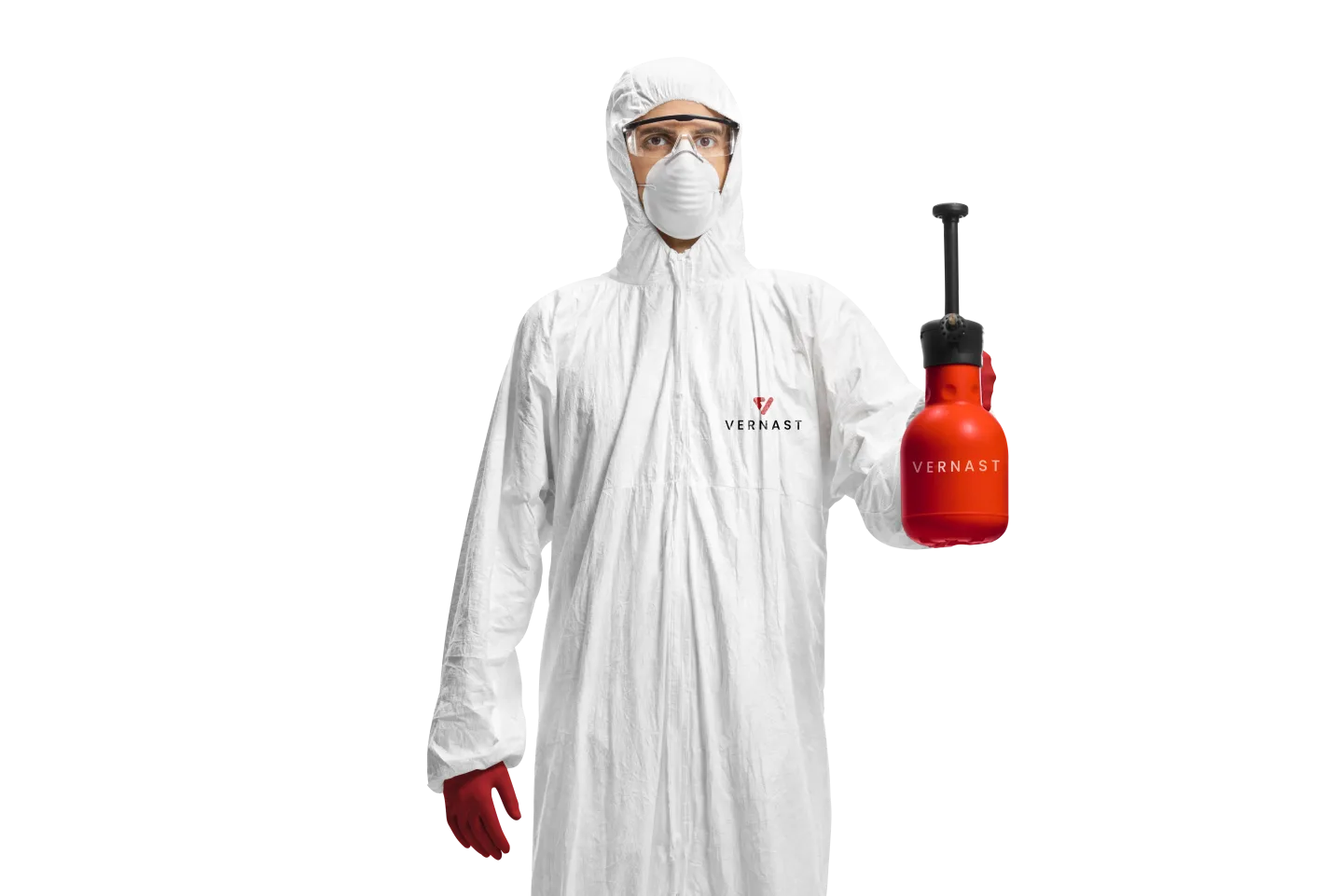
From a single corner to an entire cellar.
Mould looks different everywhere. These are the situations people call us for.
Black patches on the wall
The classic: a cold outside wall behind a wardrobe, or the corner of a bedroom that never dries out.
Cellars & crawl spaces
Damp, poorly ventilated spaces where mould can spread unseen for months before anyone smells it.
After water damage
After a leak or a flood, mould starts within 24 to 48 hours. Drying and removing mould quickly can save you a renovation.
Musty smell, no stain
You can smell it but see nothing: then the mould is behind the skirting board, under the floor or in the cavity wall.
Allergies and airways
Recurring complaints in children or in people with asthma that are worse at home than elsewhere.
When buying or letting
Mould noted in an inventory report, or discovered just before a home changes hands.
Without contaminating the rest of your home.
Removing mould stirs up spores. That is why we work in a sealed-off area, with the right protection, and the affected material leaves the house sealed.
The room is closed off from the rest of the home, so that dust and spores don't travel to the hallway or the bedrooms.
Our technicians wear a suit and mask. Not for show: removal releases spores you don't want to breathe in.
Affected plasterwork, wallpaper or plasterboard leaves the home packed up, so the contamination doesn't get loose on the way out.
If the problem lies in the structure, we'll tell you. Sometimes a damp-proof injection or better ventilation is the real answer, not our treatment.
How we work, in their words.
Reviews of Vernast on Google and Solvari, quoted word for word (in Dutch). About speed, follow-up and keeping appointments, because that is what work in your home requires.
Snelle respons en dezelfde dag nog een droger geïnstalleerd. Top service!
Zeer goede service en flexibiliteit. Werken zijn uitstekend uitgevoerd. Vriendelijk personeel. Firma zeker aan te raden.
We zijn bijzonder tevreden. Het personeel is professioneel én vriendelijk. Het werk is grondig uitgevoerd. Bovendien werd het achteraf goed opgevolgd.
Your questions about mould removal.
Can't find your question?
Our specialist comes to have a look free of charge and tells you honestly what needs to be done, and in what order.
Can't I just clean the mould off myself? +
Surface cleaning removes the black stain, but not the mould. The threads sit in the pores of plaster and joints, and wiping it dry actually releases spores that settle elsewhere in the room. That is why we work in a sealed-off area, with negative pressure where needed, and first remove the affected material before we treat.
How much does mould removal cost? +
That depends on the surface area, how deep the mould goes and whether the affected material has to be removed. A wall of a few square metres in a bedroom is different from a cellar where the plasterwork has to come off. Our specialist comes to have a look and gives you a fixed price before anything is done.
Do I have to leave the house during the work? +
Usually not. We seal off the work area so that dust and spores don't spread through the home, and work room by room. Only during any ozone treatment afterwards does the treated room have to stay empty for a few hours, including pets and plants.
How do I know the damp problem has been solved? +
By measuring, not by looking. We measure the moisture content of the substrate before and after drying. A wall that looks dry can still be wet inside, and then the mould comes back, however thoroughly the surface has been treated. Only when the reading says dry do we finish off.
What is the difference with an ozone treatment? +
Mould removal is the hands-on work: the visible mould and the affected material go, and the substrate is treated. An ozone treatment is the finishing step afterwards: it clears up the spores left behind in the air, in cracks and in fabrics. One does not replace the other, they follow each other.
Is mould in the home really unhealthy? +
Mould spores can trigger respiratory complaints, headaches and fatigue, and they hit children, older people and people with asthma or an allergy hardest. That is also the reason not to wait: the longer the room stays damp, the bigger the colony and the more spores get into the air.
Mould in your home? Have someone look at it first.
Describe your situation below and a specialist will call you within one working day. The visit is free and without obligation, and you get a fixed price before anything is done.
- Response within one working day
- Honest advice: sometimes drying or ventilating is the real answer
- Working throughout Flanders
Rather call straight away? 03 689 90 65, Mon–Fri, 8am–5pm