
Condensation or desiccant dehumidifier: which one do you need?
Both machines remove moisture from the air, but in completely different ways. As a result, one works best in a warm house and the other in a cold cellar or under a floor. Here you can read how they work, where the temperature limit lies and which machine from our range suits your situation.
How a condensation dehumidifier works
A condensation dehumidifier works like a small fridge with a fan. It draws in the moist indoor air and passes it over a cold element. There the air cools below its dew point, and the water vapour settles as liquid water, just as a cold glass gets wet on the outside in summer. That water runs into a tank or is pumped away with a condensate pump. The air then passes the warm part of the refrigeration circuit and leaves the machine drier and slightly warmer than when it came in.
That principle is efficient as long as the air is warm and humid. Warm air holds a lot of water vapour, so every time it passes the cold element, a lot condenses. That is why the condensation dehumidifier is the standard machine for screed and plasterwork in a heated building and for most water damage.
Why a condensation dehumidifier loses efficiency in the cold
Cold air holds little water vapour. The gap between the air temperature and the dew point gets smaller, and the cold element can also start to freeze; the machine then has to defrost regularly instead of drying. Below about 15 °C the efficiency of a condensation dehumidifier drops noticeably, and below 10 °C drying becomes really slow. Our condensation dehumidifiers are rated for an operating range of 5 – 32 °C, but at the lower end of that range they come nowhere near their full capacity.
In a cold cellar or an unheated winter site there is therefore a choice: heat the room with an electric site heater so the condensation dehumidifier works at full power again, or choose a machine that does not mind the cold.
How a desiccant dehumidifier works
A desiccant dehumidifier does not cool anything. Inside, a rotor turns with a moisture-absorbing material, often silica gel. The water vapour in the air attaches to that material, and the air that comes out is very dry. A second, heated airflow draws the moisture back out of the rotor and carries it away as moist air, usually outside through a duct. So no condensate ends up in a tank.
Because that process does not rely on cooling, a desiccant dehumidifier also works at low temperatures with little loss. An added advantage: the dry air can be ducted exactly where it is needed, such as under a floating floor, behind a dry-lined wall or into the insulation. After water damage, that often makes the difference between drying and ripping out. The drawback: at room temperature a condensation dehumidifier usually extracts more litres per kWh, and a desiccant dehumidifier needs an outlet to the outside.
Which machine for which situation?
| Situation | Best choice |
|---|---|
| Screed or plasterwork in a heated new build | Condensation dehumidifier, with fan |
| Water damage in an occupied, heated home | Condensation dehumidifier, with fans |
| Cold cellar or winter site, heating possible | Condensation dehumidifier with site heater |
| Cold room you do not want to or cannot heat | Desiccant dehumidifier |
| Water under a floating floor, in a wall or in insulation | Desiccant dehumidifier with ducts |
Not sure, for example with a cellar that is half below ground and half heated? Then it usually makes sense to measure first what the temperature and humidity really are. Our customer service will help you think it through.
You can hire these machines from us
Daily prices as shown on the machine pages and in the booking module. You collect individual machines from our warehouse in Aartselaar; a complete package with delivery is calculated in the drying calculator.
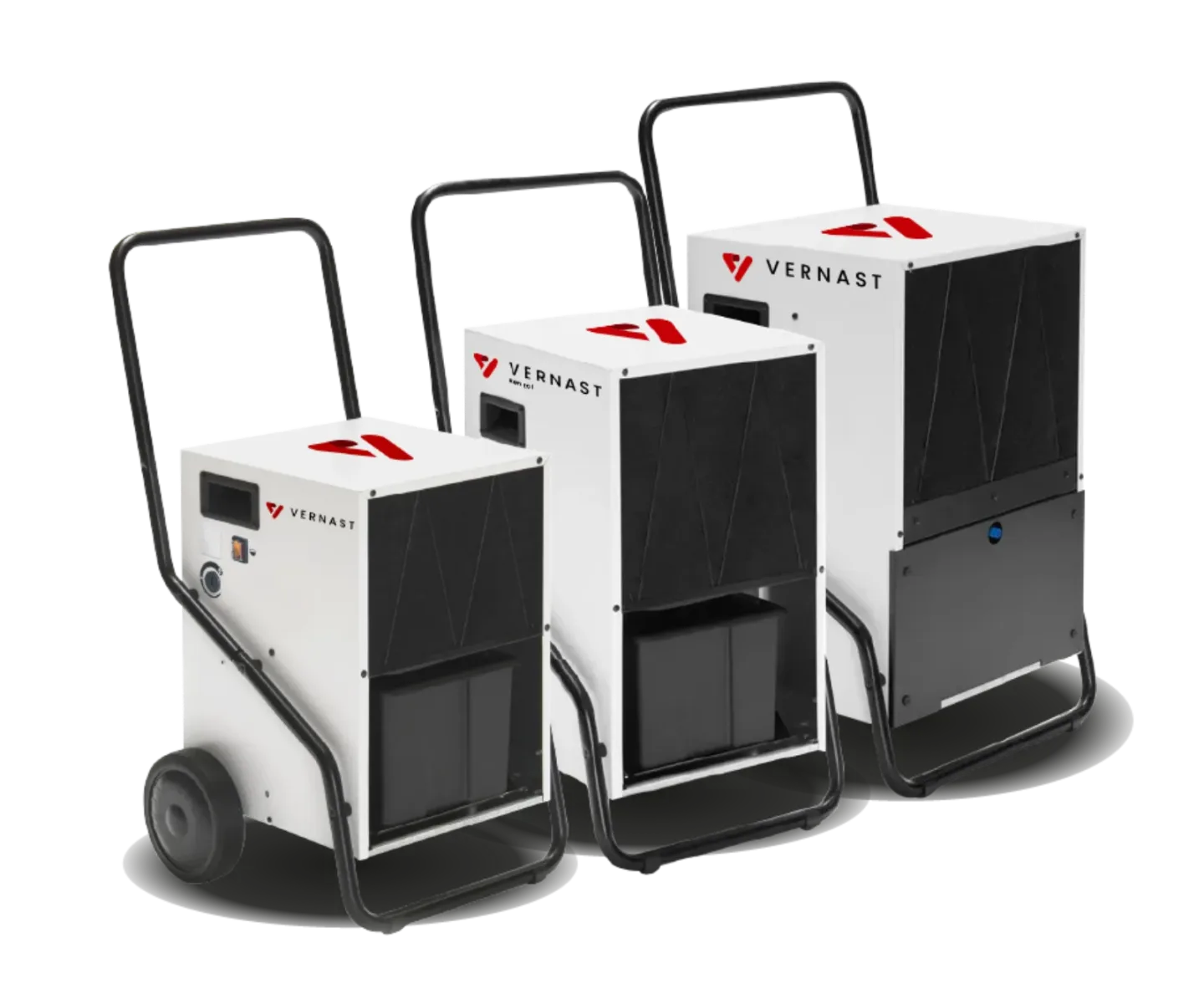
Boost construction dehumidifier
Condensation · up to 50 L per day · rooms up to 250 m³
€10.89 per day, incl. VAT
Compact condensation dehumidifier on wheels. The right choice for a single room, a flat or a smaller renovation.
View the BoostPerformance construction dehumidifier
Condensation · up to 70 L per day · rooms up to 400 m³
€14.52 per day, incl. VAT
Our most hired unit and the standard for new builds. Dries screed and plaster reliably within a few days.
View the PerformanceUltimate construction dehumidifier
Condensation · up to 110 L per day · rooms up to 600 m³
€19.36 per day, incl. VAT
The most powerful unit in the range. For large sites, cellars and water damage where every day counts.
View the UltimateRevolution desiccant dehumidifier
Desiccant
€30.25 per day, incl. VAT
Dries in a targeted way through hoses: under floors, inside walls and in hard-to-reach places. Also works at low temperatures.
View the RevolutionIn short
Is your question not listed?
Our drying experts will help you straight away, with advice tailored to your situation.
A condensation dehumidifier cools the air below its dew point, so the water vapour condenses into water that you drain away. A desiccant dehumidifier draws the water vapour out of the air with a moisture-absorbing material and blows the moist air outside through a duct. The first works best in a warm room, the second keeps working in the cold.
Below about 15 °C the efficiency of a condensation dehumidifier drops noticeably, and below 10 °C drying becomes really slow. In a cold cellar or an unheated site we therefore add a site heater, or we opt for a desiccant dehumidifier.
When it is cold and you do not want to or cannot heat, and when the moisture is somewhere an ordinary construction dehumidifier cannot reach, such as under a floating floor or inside a wall build-up after water damage. Through ducts, a desiccant dehumidifier blows dry air exactly to that spot.
In practice, yes. A construction dehumidifier is a powerful dehumidifier for building and renovation work. Our construction dehumidifiers are condensation dehumidifiers; the desiccant dehumidifier is a separate machine for targeted and cold drying.